

UV-Curable Ink and Customization Trends Drive Direct-to-Shape Inkjet Printer Market to Achieve 2.3% CAGR Growth by 2034 | Future Market Insights, Inc.
Direct-to-shape inkjet printers are revolutionizing packaging with eco-friendly, personalized solutions. Key drivers include sustainability, Industry 4.0 adoption, and automation, offering growth in emerging markets.
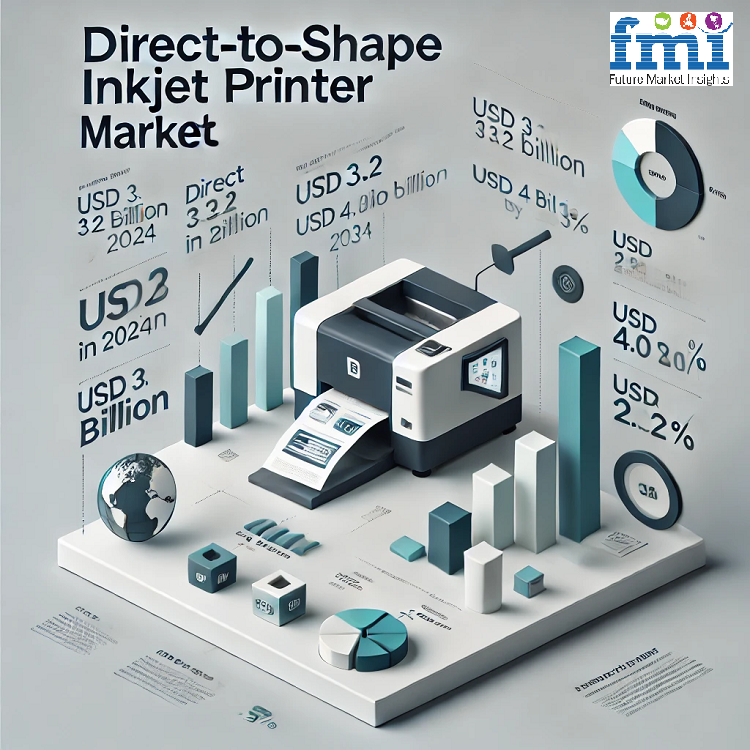
NEWARK, Del, Oct. 02, 2024 (GLOBE NEWSWIRE) -- The Direct-to-shape Inkjet Printer Market is projected to grow from USD 3.2 billion in 2024 to USD 4.0 billion by 2034, reflecting a CAGR of 2.3% over the forecast period. This market growth is driven by increased demand for customizable packaging solutions and advancements in digital printing technologies, allowing manufacturers to print directly on various surfaces.
Direct-to-shape inkjet printers are becoming increasingly popular in industries like food & beverage, cosmetics, and consumer goods, where personalized, high-quality packaging is essential. These printers offer flexibility in design and allow for on-demand printing, reducing waste and enhancing production efficiency.
Technological advancements in the Thermal Inkjet Inks industry have enabled faster printing speeds, improved print resolutions, and enhanced capabilities to print on complex surfaces. This progress is particularly prominent in regions like North America and Europe, where the demand for sustainable and efficient printing technologies is high. Thermal inkjet inks, known for their eco-friendly properties and precision, are increasingly being adopted in various industries to meet these demands, driving growth in both markets.
In the coming decade, the market will face challenges, including the high initial costs of advanced inkjet systems and maintenance. However, the cost-effectiveness and eco-friendliness of direct-to-shape printing solutions will continue to drive their adoption across multiple sectors.
Drivers and Opportunities:
The increasing demand for eco-friendly packaging, the shift toward personalized consumer products, and the rise of Industry 4.0 in manufacturing processes are key drivers fueling the growth of the Direct-to-shape Inkjet Printer Market. Opportunities also exist in emerging economies where industrial printing processes are being modernized.
Sustainability trends are playing a pivotal role, with direct-to-shape inkjet printing reducing the need for additional labels and adhesives, thereby minimizing material usage. Innovations in ink formulations, such as water-based, UV-curable, and continuous inkjet inks, are driving environmentally friendly printing solutions. Continuous inkjet inks, known for their durability and efficiency, further contribute to reducing waste, making them a key component in the shift towards sustainable printing practices.
Additionally, advancements in automation and software for direct-to-shape printing offer opportunities for market players to enhance their productivity and deliver more customized solutions.
Key Takeaways from the Market Study:
- The Direct-to-shape Inkjet Printer Market is expected to reach USD 4.0 billion by 2034.
- Growing demand for sustainable, customizable packaging solutions is a major driver.
- North America and Europe are leading the market in terms of innovation and adoption.
- High initial costs of advanced systems remain a challenge, but the overall cost-effectiveness is pushing adoption.
“The direct-to-shape inkjet printer market is poised for strong growth, driven by rising demand for personalized products and sustainable solutions. Its cost-effectiveness, combined with advancements in UV-curable inks and digital transformation, positions it as a key technology for manufacturers seeking efficient, eco-friendly printing,” says a Lead Consultant Ismail Sutaria in Packaging at Future Market Insights (FMI).
Direct-to-shape Inkjet Printer Market: Report Scope
| Parameter | Details | |
| Base Year for Market Estimation | 2023 | |
| Forecast Period | 2024 to 2034 | |
| Market Size (2024) | USD 3.2 billion | |
| Market Size (2034) | USD 4.0 billion | |
| CAGR (2024 to 2034) | 2.3% | |
| Major Regions | North America, Europe, APAC | |
| Key Applications | Packaging, Consumer Goods | |
Market's Prime Determinants of Growth, Trends, and Opportunities:
- Sustainability: The demand for environmentally friendly printing solutions, including reduction in labels and packaging waste, is driving the adoption of direct-to-shape inkjet printers.
- Customization: Brands are increasingly seeking flexible, customizable packaging options to stand out in competitive markets, fueling demand for direct-to-shape technology.
- Technological Advancements: Continued improvements in printing speed, printhead durability, and ink formulations will expand the market’s potential in industrial and consumer applications.
- Regional Trends: North America and Europe remain leaders in this market, while emerging economies in Asia-Pacific present growth opportunities due to industrial modernization and increased consumer demand for personalized goods.
Key Companies & Market Share Insights:
Leading companies in the Direct-to-shape Inkjet Printer Market include:
- Xerox Corporation
- Heidelberg USA, Inc.
- Mimaki Europe B.V.
- Xaar plc
- Koenig & Bauer AG
- Tonejet Limited
- Velox Ltd.
- Epson America, Inc.
- INX International Ink Co.
- Roland DG Corporation
- LogoJET
- DMPS CO.LTD.
- Azonprinter d.o.o.
- Sun 3D Corporation
- SelectedJET
These companies are focusing on technological innovations and strategic partnerships to expand their market presence and enhance their product portfolios.
Country-wise Analysis of the Direct-to-Shape Inkjet Printer Market:
| Region | Country | CAGR (2024-2034) | Market Insights | |
| North America | United States | 0.8 | % | Regulatory frameworks and environmental concerns drive the market. Growth in customized packaging and branding boosts demand for inkjet printers. |
| Canada | 0.5 | % | Increasing focus on recyclable materials and eco-consciousness. R&D investments foster innovation in direct-to-shape inkjet printing. | |
| Europe | Germany | 0.6 | % | Sustainability initiatives and the booming automotive industry enhance demand for environmentally friendly and customizable printing solutions. |
| United Kingdom | 0.8 | % | Packaging innovation, especially in the food and beverage industry, drives the demand for bespoke consumer goods using direct-to-shape inkjet printers. | |
| France | 1.3 | % | The emphasis on luxury aesthetics, especially in the cosmetics sector, increases the demand for product customization using inkjet printers. | |
| Italy | 0.8 | % | SMEs in Italy adopt inkjet printers for functional, detailed designs in packaging, supporting the country’s focus on aesthetics and vibrant colors. | |
| Spain | 2.4 | % | Spain’s tourism industry fuels demand for personalized packaging, branding, and keepsakes, pushing growth in the inkjet printing market. | |
| Asia Pacific | India | 5.5 | % | Government initiatives like "Make in India" and rising disposable incomes foster demand for customized packaging solutions through inkjet printers. |
| China | 4.9 | % | Rapid urbanization, e-commerce growth, and the focus on automation in manufacturing spur the adoption of direct-to-shape inkjet printers. | |
| Japan | 1.9 | % | Demand for innovative packaging grows due to changing demographics, with IoT-enabled printers playing a role in real-time manufacturing process optimization. | |
| South Korea | 2.4 | % | The "Korean Wave" (Hallyu) boosts demand for personalized packaging, and companies explore eco-friendly inks and substrates in line with global sustainability trends. | |
| Thailand | 4.1 | % | Rising consumer demand for upscale and personalized packaging solutions is creating opportunities for inkjet printers, especially in labeling and product traceability. | |
Unlock Comprehensive Market Insights – Explore the Full Report Now: https://www.futuremarketinsights.com/reports/direct-to-shape-inkjet-printing-market
Growth Drivers:
- Customization Trends: The growing demand for personalized packaging in industries such as beverages, cosmetics, and consumer goods is a major driver for market growth.
- Eco-friendly Solutions: The shift toward sustainable packaging practices is prompting industries to adopt direct-to-shape printers that reduce packaging waste.
-
Technological Innovation: Improvements in print speed, ink technology, and software integration are enhancing the capabilities and appeal of direct-to-shape printing solutions.
Key Segments
By Ink Type:
- Solvent Based
- Water Based
- UV Curing Inks
By Substrate Type:
- Plastic
- Glass
- Metal
- Paper
- Fabric
- Wood
By Application:
- Bottles
- Cans
- Drums
- Tubes
- Folding Cartons
- Others
By End Use:
- Food
- Beverages
- Pharmaceutical
- Cosmetics
- Personal Care and Homecare
- Chemical
- Other
By Region:
- North America
- Latin America
- Europe
- Middle East and Africa
- East Asia
- South Asia
- Oceania
Old Publication: https://finance.yahoo.com/news/direct-shape-inkject-printers-market-002000900.html
Der Markt für Direct-to-Shape-Tintenstrahldrucker soll von 3,2 Milliarden USD im Jahr 2024 auf 4,0 Milliarden USD im Jahr 2034 wachsen, was einer durchschnittlichen jährlichen Wachstumsrate von 2,3 % im Prognosezeitraum entspricht. Dieses Marktwachstum wird durch die gestiegene Nachfrage nach anpassbaren Verpackungslösungen und Fortschritte bei digitalen Drucktechnologien vorangetrieben, die es Herstellern ermöglichen, direkt auf verschiedene Oberflächen zu drucken.
Direct-to-Shape-Tintenstrahldrucker erfreuen sich in Branchen wie der Lebensmittel- und Getränkeindustrie, Kosmetik und Konsumgütern, in denen personalisierte, hochwertige Verpackungen unverzichtbar sind, zunehmender Beliebtheit. Diese Drucker bieten Flexibilität im Design und ermöglichen On-Demand-Druck, wodurch Abfall reduziert und die Produktionseffizienz gesteigert wird.
Technologische Fortschritte in der Branche der Thermotintenstrahltinten haben schnellere Druckgeschwindigkeiten, verbesserte Druckauflösungen und erweiterte Möglichkeiten zum Bedrucken komplexer Oberflächen ermöglicht. Dieser Fortschritt ist besonders in Regionen wie Nordamerika und Europa ausgeprägt, wo die Nachfrage nach nachhaltigen und effizienten Drucktechnologien hoch ist. Thermotintenstrahltinten, die für ihre umweltfreundlichen Eigenschaften und Präzision bekannt sind, werden in verschiedenen Branchen zunehmend eingesetzt, um diese Nachfrage zu erfüllen, und treiben das Wachstum in beiden Märkten voran.
Im kommenden Jahrzehnt wird der Markt vor Herausforderungen stehen, darunter die hohen Anschaffungskosten moderner Tintenstrahlsysteme und deren Wartung. Die Kosteneffizienz und Umweltfreundlichkeit von Direct-to-Shape-Drucklösungen werden jedoch weiterhin zu ihrer Einführung in vielen Branchen führen.
Treiber und Chancen:
Die steigende Nachfrage nach umweltfreundlichen Verpackungen, der Trend zu personalisierten Konsumprodukten und der Aufstieg von Industrie 4.0 in Herstellungsprozessen sind die Haupttreiber für das Wachstum des Marktes für Direct-to-Shape-Tintenstrahldrucker. Chancen ergeben sich auch in Schwellenländern, in denen industrielle Druckprozesse modernisiert werden.
Nachhaltigkeitstrends spielen eine entscheidende Rolle. Der Direct-to-Shape-Tintenstrahldruck reduziert den Bedarf an zusätzlichen Etiketten und Klebstoffen und minimiert so den Materialverbrauch. Innovationen bei Tintenformulierungen wie wasserbasierten, UV-härtenden und Continuous-Inkjet-Tinten treiben umweltfreundliche Drucklösungen voran. Continuous-Inkjet-Tinten, die für ihre Haltbarkeit und Effizienz bekannt sind, tragen zusätzlich zur Abfallreduzierung bei und sind damit eine Schlüsselkomponente bei der Umstellung auf nachhaltige Druckpraktiken.
Darüber hinaus bieten Fortschritte in der Automatisierung und Software für den Direct-to-Shape-Druck den Marktteilnehmern die Möglichkeit, ihre Produktivität zu steigern und individuellere Lösungen anzubieten.
Wichtige Erkenntnisse aus der Marktstudie:
- Der Markt für Direct-to-Shape-Tintenstrahldrucker soll bis 2034 ein Volumen von 4,0 Milliarden US-Dollar erreichen.
- Ein wichtiger Treiber ist die wachsende Nachfrage nach nachhaltigen, anpassbaren Verpackungslösungen.
- Nordamerika und Europa sind hinsichtlich Innovation und Akzeptanz Marktführer.
- Die hohen Anschaffungskosten fortschrittlicher Systeme stellen weiterhin eine Herausforderung dar, die allgemeine Kosteneffizienz fördert jedoch deren Einführung.
Wichtigste Marktfaktoren für Wachstum, Trends und Chancen:
- Nachhaltigkeit: Die Nachfrage nach umweltfreundlichen Drucklösungen, einschließlich der Reduzierung von Etiketten- und Verpackungsabfällen, treibt die Einführung von Direct-to-Shape-Tintenstrahldruckern voran.
- Individualisierung: Marken suchen zunehmend nach flexiblen, individualisierbaren Verpackungsoptionen, um sich auf wettbewerbsintensiven Märkten abzuheben, was die Nachfrage nach Direct-to-Shape-Technologie ankurbelt.
- Technologischer Fortschritt: Kontinuierliche Verbesserungen der Druckgeschwindigkeit, der Druckkopfhaltbarkeit und der Tintenzusammensetzungen werden das Marktpotenzial für Industrie- und Verbraucheranwendungen erweitern.
- Regionale Trends: Nordamerika und Europa bleiben auf diesem Markt führend, während die Schwellenländer im asiatisch-pazifischen Raum aufgrund der industriellen Modernisierung und der gestiegenen Verbrauchernachfrage nach personalisierten Waren Wachstumschancen bieten.
Wichtige Unternehmen und Einblicke in die Marktanteile:
Zu den führenden Unternehmen auf dem Markt für Direct-to-Shape-Tintenstrahldrucker gehören:
- Xerox Corporation
- Heidelberg USA, Inc.
- Mimaki Europe BV
- Haar plc
- Koenig & Bauer AG
- Tonejet Limited
- Velox GmbH
- Epson America, Inc.
- INX International Ink Co.
- Roland DG Corporation
- LogoJET
- DMPS CO.LTD.
- Azonprinter doo
- Sun 3D Corporation
- AusgewähltJET
Diese Unternehmen konzentrieren sich auf technologische Innovationen und strategische Partnerschaften, um ihre Marktpräsenz auszubauen und ihr Produktportfolio zu erweitern.
Wachstumstreiber:
- Individualisierungstrends: Die steigende Nachfrage nach personalisierten Verpackungen in Branchen wie der Getränke-, Kosmetik- und Konsumgüterindustrie ist ein wichtiger Treiber für das Marktwachstum.
- Umweltfreundliche Lösungen: Der Wandel hin zu nachhaltigeren Verpackungspraktiken veranlasst die Industrie dazu, Direct-to-Shape-Drucker einzusetzen, die den Verpackungsmüll reduzieren.
-
Technologische Innovation: Verbesserungen bei Druckgeschwindigkeit, Tintentechnologie und Softwareintegration steigern die Leistungsfähigkeit und Attraktivität von Direct-to-Shape-Drucklösungen.
Schlüsselsegmente
Nach Tintentyp:
- Lösungsmittelbasiert
- Auf Wasserbasis
- UV-härtende Tinten
Nach Substrattyp:
- Plastik
- Glas
- Metall
- Papier
- Stoff
- Holz
Nach Anwendung:
- Flaschen
- Dosen
- Schlagzeug
- Schläuche
- Faltschachteln
- Sonstiges
Nach Endverwendung:
- Essen
- Getränke
- Pharmazeutische
- Kosmetika
- Körperpflege und Heimpflege
- Chemisch
- Andere
Nach Region:
- Nordamerika
- Lateinamerika
- Europa
- Naher Osten und Afrika
- Ostasien
- Südasien
- Ozeanien
Authored by:
Ismail Sutaria (Lead Consultant, Packaging and Materials) has over 8 years of experience in market research and consulting in the packaging & materials industry. Ismail’s strength lies in identifying key challenges faced by the client and offering logical and actionable insights to equip the clients with strategic decision-making power.
Ismail has been an instrumental part of several transformational consulting assignments. His key skills include competitive benchmarking, opportunity assessment, macroeconomic analysis, and business transformation advisory. Ismail is an MBA holder in Marketing and has a Bachelor’s Degree in Mathematics.
Have a Look at Trending Research Reports on Packaging Domain:
The global digital textile printer market value is projected to increase from US$ 2,212.9 million in 2023 to US$ 5,304.3 million by 2033. Over the forecast period 2023 to 2033, global digital textile printer demand is expected to rise at a CAGR of 9.8%.
The global inkjet printers market size is expected to be valued at US$ 7.0 billion in 2023. Growing eCommerce industry, bolsters the overall scope for inkjet printers market, which is projected to grow at a CAGR of 5.2% between 2023 and 2033, totaling around US$ 11.6 billion by 2033.
The ID card printer market demand is slated to rise and equate to a market valuation of US$ 155.1 million, with a CAGR of 2.40% in the intervening period, by 2034.
The global sales of corrugated box printer slotter machine are anticipated to reach a value of USD 1.8 billion by 2031. Sales are projected to rise at a CAGR of 4.5% over the forecast period between 2021 and 2031.
The global share of NCR (No Carbon Required) printers is anticipated to reach a value of USD 3.0 billion by 2031. Sales are projected to rise at a CAGR of 5.1% over the forecast period between 2021 and 2031. The revenue generated by NCR printers in 2020 was USD 1.7 billion.
The industrial printers industry demand is poised to grow at a rate of 5.5% till 2034. The report predicts the overall market value to reach almost US$ 26,814.1 million by the end of the forecast period.
The multi-color printer market value is envisioned to reach USD 63.7 billion by 2034. The substantial expansion is forecasted to be driven by an unhurried CAGR of 2.5% from 2024 to 2034.
The printer ribbon market size is predicted to expand at a sluggish 3.2% CAGR during the forecast period. The industry’s revenue stands at USD 3.2 billion in 2024 and is projected to surpass USD 4.4 billion by 2034.
The global screen printing mesh industry is predicted to register a CAGR of 4.10% during the forecast period and reach US$ 1,134.2 million by 2033.
The global pad printing machine market sales are expected to record a CAGR of 5.3% between 2023 and 2033, reaching US$ 1,897.8 million by the end of the assessment period.
About Future Market Insights (FMI)
Future Market Insights, Inc. (ESOMAR certified, recipient of the Stevie Award, and a member of the Greater New York Chamber of Commerce) offers profound insights into the driving factors that are boosting demand in the market. FMI stands as the leading global provider of market intelligence, advisory services, consulting, and events for the Packaging, Food and Beverage, Consumer, Technology, Healthcare, Industrial, and Chemicals markets. With a vast team of over 400 analysts worldwide, FMI provides global, regional, and local expertise on diverse domains and industry trends across more than 110 countries.
Join us as we commemorate 10 years of delivering trusted market insights. Reflecting on a decade of achievements, we continue to lead with integrity, innovation, and expertise.
Contact Us:
Future Market Insights Inc.
Christiana Corporate, 200 Continental Drive,
Suite 401, Newark, Delaware - 19713, USA
T: +1-845-579-5705
For Sales Enquiries: sales@futuremarketinsights.com
Website: https://www.futuremarketinsights.com
LinkedIn| Twitter| Blogs | YouTube


Legal Disclaimer:
EIN Presswire provides this news content "as is" without warranty of any kind. We do not accept any responsibility or liability for the accuracy, content, images, videos, licenses, completeness, legality, or reliability of the information contained in this article. If you have any complaints or copyright issues related to this article, kindly contact the author above.
